Information stealers (infostealer) have become a significant part of the modern cybercrime ecosystem. Rather than focusing on persistence or destructive activity, these malware families are designed to quickly collect valuable information from an infected system, including browser credentials, session data, cryptocurrency wallets, messaging applications, and other information that can be monetized or used for additional attacks.
PhantomStealer4 is one of the new popular .NET-based infostealers we have been analyzing. During our research, we observed functionality designed to collect browser data, cryptocurrency wallet information, Exodus wallet data, Telegram data, and other information from compromised systems.
From a malware-analysis perspective, however, identifying what an infostealer collects is only part of the investigation.
The configuration embedded within a malware sample can be particularly valuable. It can reveal how the malware is configured to operate and may expose information such as command-and-control infrastructure, campaign settings, enabled functionality, or other operational parameters. Extracting this information across multiple samples can help researchers move beyond analyzing a single executable and begin identifying relationships between campaigns and infrastructure.
The challenge is that malware developers rarely make this information easy to retrieve.
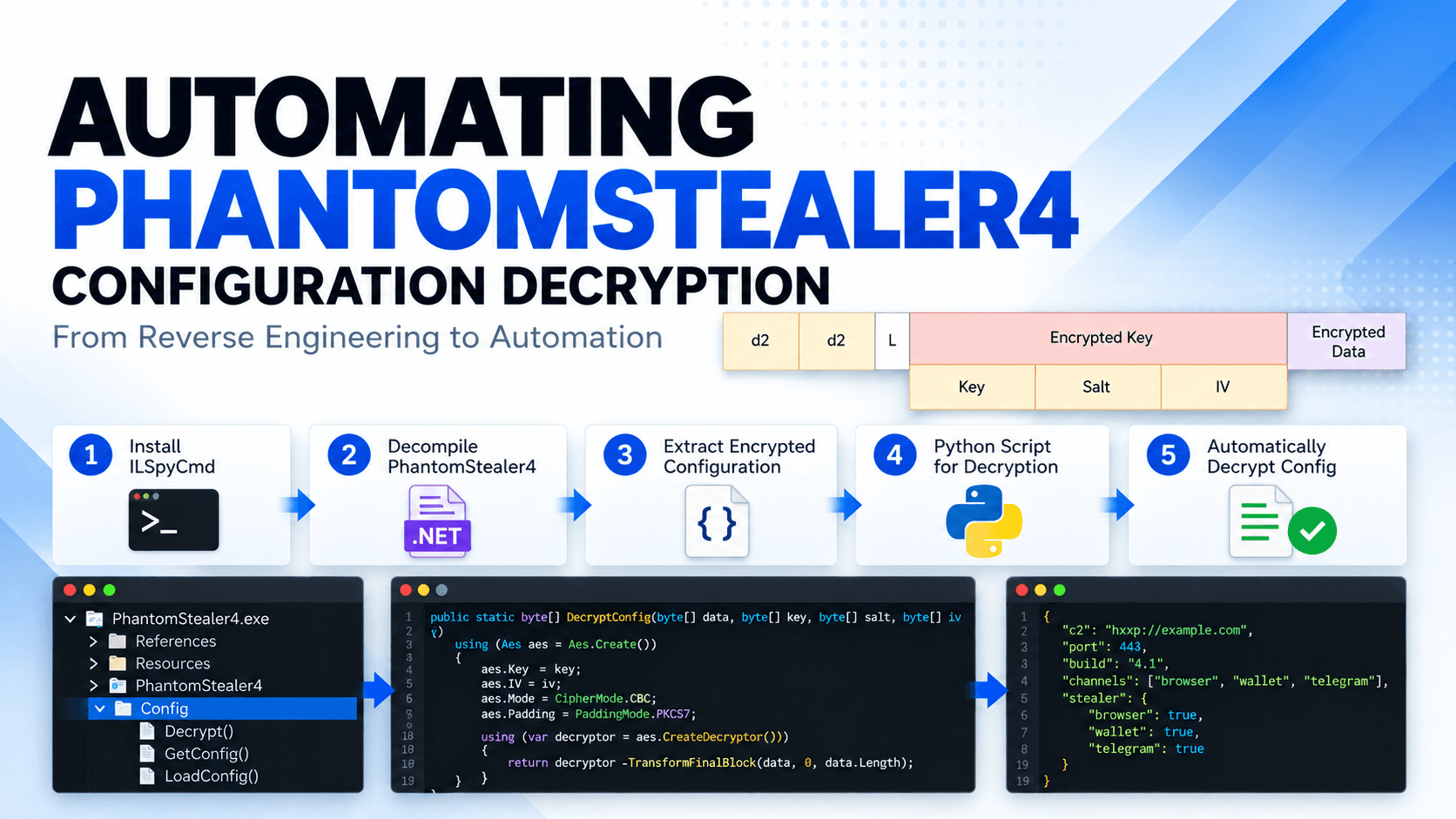
PhantomStealer4 stores important data in an encrypted structure embedded within the malware. Before we can reliably extract the configuration, we first need to understand how the structure is constructed, where the cryptographic material is stored, and how the malware itself decrypts the data at runtime.
This is where reverse engineering becomes particularly useful.
In the first part of this research, we take the manual approach. We analyze PhantomStealer4 using static analysis and dnSpy, locate the encrypted data, study its structure, and reverse engineer the decryption algorithm. We then reproduce the process using CyberChef and Python to verify that we correctly understand how the malware decrypts its configuration.
But manually repeating those steps every time we encounter another sample does not scale.
Once we understand the underlying format and algorithm, the next objective is to turn that knowledge into something repeatable:
Can we automatically extract and decrypt a PhantomStealer4 configuration directly from a malware sample?
That becomes the focus of the second part of the research. Using ILSpyCmd and Python, we take what we learned during manual reverse engineering and turn it into an automated PhantomStealer4 configuration-decryption workflow.
The progression is straightforward:
Reverse Engineer → Understand → Reproduce → Automate
Want to detect threats 8+ months earlier?
See how DarkArmor's PreBreach intelligence can protect your organization.