Introduction — Malware Infrastructure Is Evolving
Traditional malware often stores command-and-control (C2) servers directly inside the binary. Once defenders identify the infrastructure, domains and servers can be blocked or seized.
Cybercriminals understand this weakness.
Over the years, malware authors have experimented with alternative ways to hide C2 infrastructure:
- Reddit posts
- Steam profiles
- Telegram bios
- Paste sites
- Social media platforms
But these methods still rely on centralized services that can be taken down.
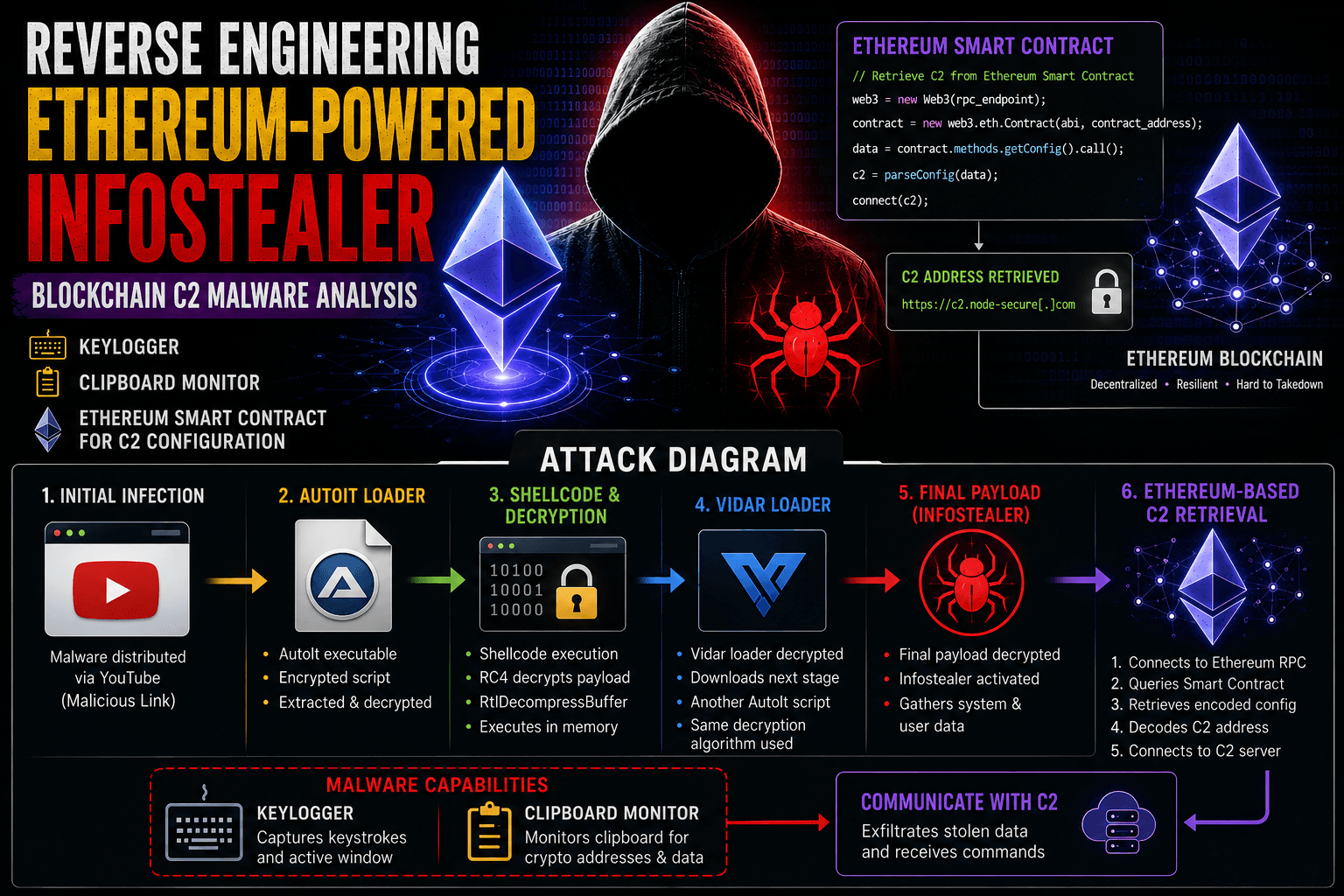
In this investigation, we analyzed a multi-stage infostealer campaign that uses the Ethereum blockchain itself to store and retrieve C2 configuration data.
Instead of embedding infrastructure inside the malware, the threat actor stores the C2 information inside an Ethereum smart contract. The malware retrieves the contract data through public Ethereum RPC APIs, extracts the configuration, and dynamically resolves the active C2 server.
The result is a far more resilient infrastructure model that is difficult to disrupt.
Initial Infection Chain
The investigation began with a suspicious executable distributed through YouTube. The threat actor uploaded a video titled “Adobe Media Encoder 2026 Crack | How To Download and Install | Full Version,” attempting to lure users into downloading a malicious executable disguised as pirated software. Figure 1 shows the youtube video.
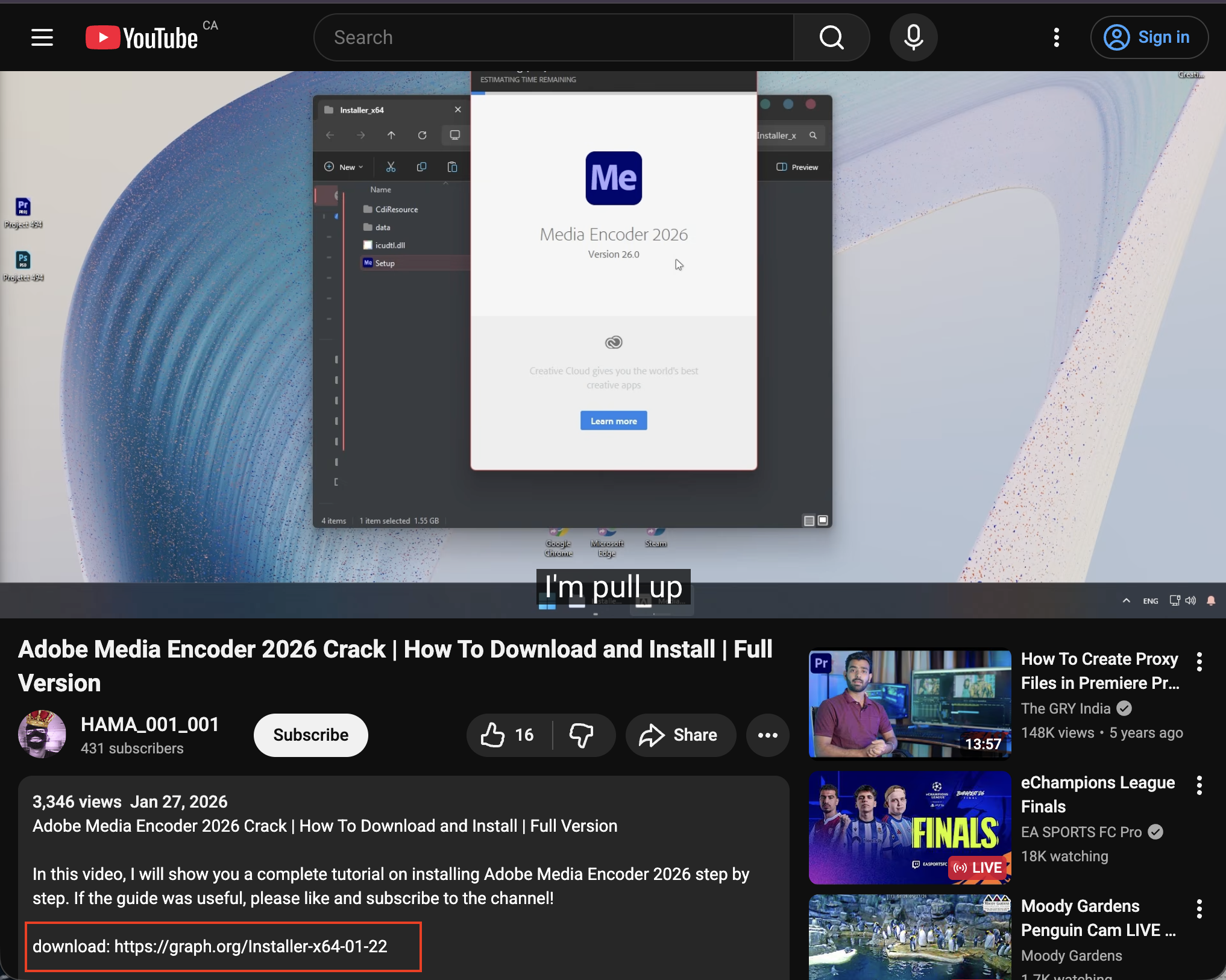
Figure 1: Reverse Engineering an Ethereum-Powered Infostealer - Youtube Video
The video describes how to install a cracked version of Adobe Media Encoder and provides instructions on where to download the file. The malicious download link was included in the video description, as shown in Figure 1.
The downloaded file has the following properties:
Filename: Installer_x64.rar
MD5: 47943a8963dd7744688d2f3393204654
SHA1: 221b91c22ca4d9c90fb119b72dc1cd76cd5017bf
SHA256: e71dc48fba30ba00f9dae175e116ec58be2c2324cafedcdae7d3b0220342ae7b
The malware has the following properties:
Filename: setup.exe
MD5: 1071781b09cbc079fd33a7ae3a39f210
SHA1: f4f5de909d79b93f680410f1379326d09e13a83f
SHA256: 1e520cc48270df92a6c2f2821fde15c9bdb7f34674c4d62f4de5e63d2c7ce190
The sample appeared to be an IExpress setup package, a legitimate executable packaging utility built into Microsoft Windows. After extracting the contents using the following command:
cmd:> setup.ie /T:c:\temp /C
the extracted files revealed that setup.exe launches an embedded AutoIt executable, which in turn executes an encrypted AutoIt script. The AutoIt script itself was heavily obfuscated and encrypted to conceal the malware’s functionality.
The AutoIt script is encrypted and it has the following properties:
Filename: Charge.a3x
MD5: 15d6988a5eec9d594e5762c6bd7a94bf
SHA1: bf52c1b3dded59db715f260ef03e69d4ea03615e
SHA256: 032a5b8beac4f16c95b8e47001a56eec96899a6ecca8a289b906e5f464a315a2
The script can be decrypt using https://github.com/digitalsleuth/autoit-extractor tool. Figure 2 show the decrypted file. The decrypted file has the following properties.
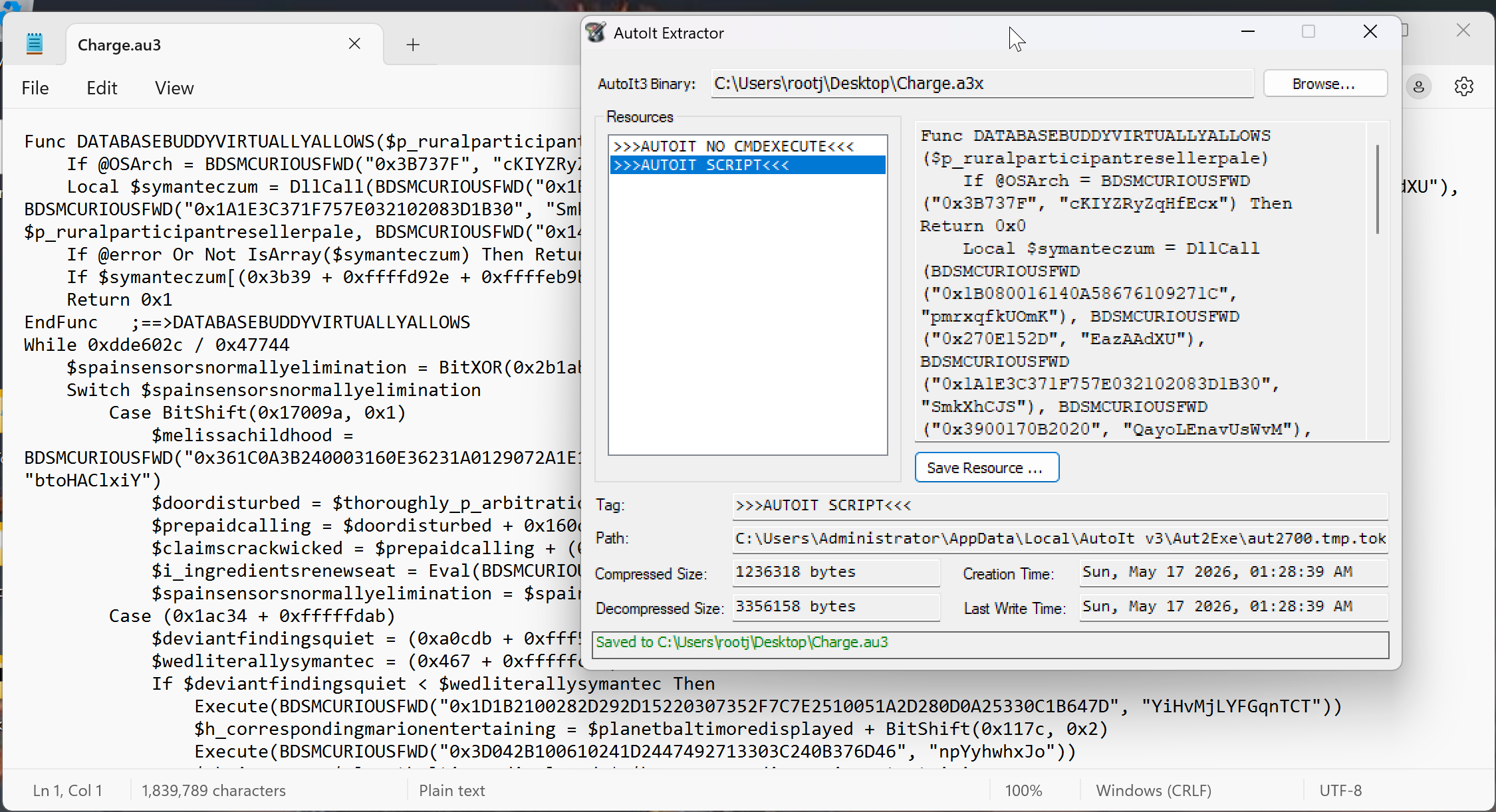
Figure 2: Decrypting Charge.a3x
Filename: Charge.au3
MD5: 17221923fd084d981249336c9ffb68cd
SHA1: b27da50bb817130f9c2974733324c7cf03a0bd29
SHA256: 4c4684d067b83aa13484950dbedc5ac3f07f23f3cba6702b9e4d816e0a2aebdc
AutoIt Loader and Shellcode Analysis
The malware:
- Loads encrypted hexadecimal payload data
- Uses RC4 to decrypt the payload
- Calls
RtlDecompressBuffer - Executes the unpacked memory region
This stage revealed the next payload:
- A Vidar loader
Why This Matters
This demonstrates a common modern malware strategy:
- Layered payloads
- Multi-stage decryption
- Memory-only execution
- Reusable loader logic
Each stage complicates analysis and detection.
Vidar Loader and Secondary Payload
The decrypted payload was identified as a Vidar-based loader.
During analysis:
- Vidar downloaded another executable
- The downloaded binary was also AutoIt-based
- The same decryption algorithm was reused
This indicates:
- Shared builder infrastructure
- Reusable malware components
- Consistent operational tooling
Eventually, the final payload was decrypted and unpacked.
The final malware was an infostealer.
Blockchain-Based Command-and-Control
The Most Interesting Discovery
Instead of hardcoding the C2 server inside the malware, the infostealer retrieves configuration data from Ethereum.
The malware:
- Connects to public Ethereum RPC APIs
- Queries a smart contract
- Extracts encoded configuration data
- Decodes the C2 address
- Connects to the active infrastructure
Example RPC Providers Used
ethereum-rpc.publicnode.comrpc.ankr.com
Why Blockchain C2 Is Dangerous
Traditional infrastructure can often be:
- Suspended
- Seized
- Sinkholed
- Blocked
Blockchain changes this model.
Key Advantages for Threat Actors
Decentralized Storage
Smart contract data cannot easily be removed.
Dynamic Infrastructure
Actors can update configuration without modifying the malware binary.
Public Infrastructure Blending
Requests to Ethereum RPC services appear legitimate.
Resilience
Even if domains are blocked, actors can rotate infrastructure through blockchain updates.
This creates a significant challenge for defenders.
InfoStealer Capabilities
After reversing the payload, we identified several core infostealer functions.
Technical Observations
Several notable characteristics stood out during analysis:
Defensive Recommendations
Organizations should consider:
- Monitoring unusual Ethereum RPC traffic
- Detecting AutoIt execution in enterprise environments
- Inspecting clipboard manipulation behavior
- Monitoring suspicious memory unpacking activity
- Identifying malware using decentralized infrastructure
Traditional IOC-based detection alone is becoming insufficient.
Behavioral analysis is increasingly important.
Summary
This campaign demonstrates how cybercriminal infrastructure is evolving beyond traditional hosting providers and centralized services.
Blockchain-based malware infrastructure introduces:
- Greater resiliency
- Dynamic reconfiguration
- Reduced takedown effectiveness
- Increased operational longevity
The future of malware infrastructure will likely continue moving toward decentralized services and legitimate platforms to blend malicious traffic with normal behavior.
The focus for defenders can no longer be limited to binaries alone.
Infrastructure behavior, execution patterns, and operational workflows are becoming just as important as malware signatures.
IOCs:
hxxps://graph[.]org/Installer-x64-01-22
hxxps://cutt[.]ly/AthF1WwA
MD5: 1071781b09cbc079fd33a7ae3a39f210
SHA1: f4f5de909d79b93f680410f1379326d09e13a83f
SHA256: 1e520cc48270df92a6c2f2821fde15c9bdb7f34674c4d62f4de5e63d2c7ce190
Want to detect threats 8+ months earlier?
See how DarkArmor's PreBreach intelligence can protect your organization.